
Losing a tooth affects not only your ability to chew comfortably but also your confidence when smiling and speaking.
If you are looking for the best solution to replace missing teeth, you are probably wondering what the difference between a dental bridge and an implant is.
Both treatments are excellent for restoring your dental aesthetics and function, bringing harmony back to your face.
However, they work in very different ways anatomically and in the long term. In this guide, we will explain everything with total clarity so you can make the best decision for your health.
Tabla de contenidos
What is a dental implant?
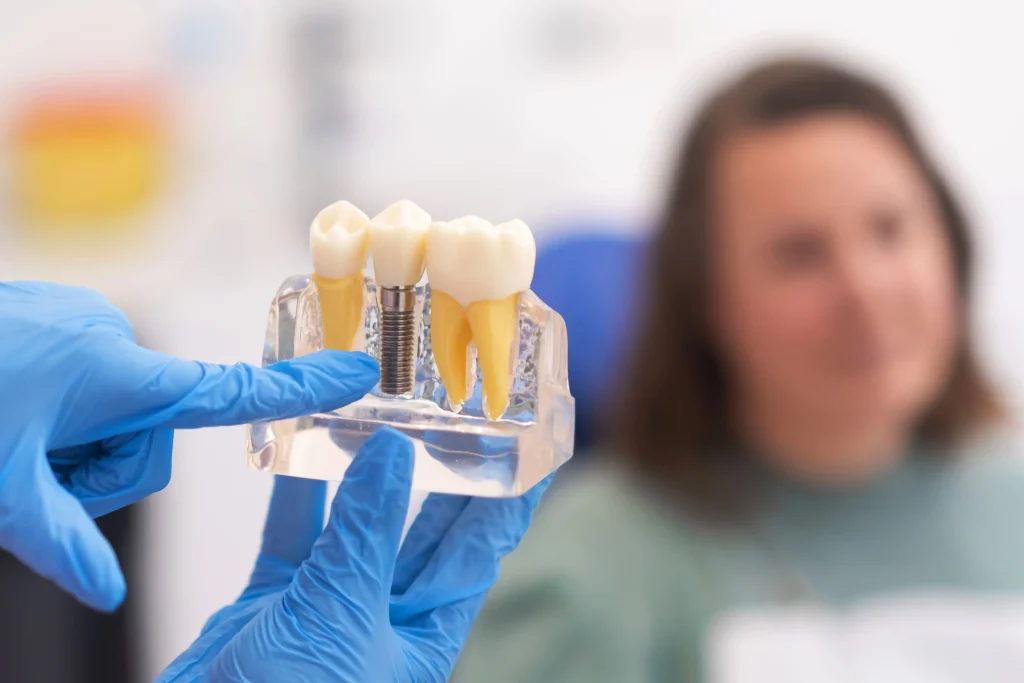
A dental implant is a small, biocompatible titanium artificial root surgically placed into the jawbone. On top of this strong, permanent post, a custom-made porcelain crown is attached, functioning and looking exactly like a healthy natural tooth.
To understand it better, imagine planting a new tree.
The implant has its own independent root under the surface and does not need to lean on anything else to stay firm.
What is a dental bridge?
A dental bridge is a fixed prosthesis designed to fill the gap of one or more missing teeth. It consists of crowns joined together, which are permanently anchored and cemented onto the healthy natural teeth on either side of the gap.
Think of a physical bridge over a river.
To stand in the air, it needs strong pillars on both banks. In your mouth, your neighboring teeth act as those structural pillars.
Main Factors: What is the difference between a dental bridge and an implant?
To fully understand the difference between a dental bridge and an implant, we must analyze how each treatment impacts your mouth’s ecosystem.
These are the three most important medical factors:
1. Care of neighboring teeth
The bridge: Requires shaving down (intentionally reshaping) the adjacent healthy teeth so the supporting crowns fit properly.
The implant: Is 100% independent. It does not touch, wear down, or compromise the health of your other natural teeth.
2. Preservation of the jawbone
The bridge: Only covers the gap on the surface. Since there is no root, the underlying bone begins to shrink over time.
The implant: Because it is anchored in the bone, it constantly stimulates it when you chew. This prevents bone loss and avoids premature facial aging.
3. Long-term durability
The bridge: A traditional prosthesis usually lasts between 10 and 15 years before needing replacement due to natural wear or changes in the gums.
The implant: Titanium fuses with your body (osseointegration). With good hygiene, it is a solution designed to last a lifetime.
Why do we recommend dental implants?
If you are looking for a definitive, highly predictable solution that protects your original bone structure, dental implants are the gold standard in modern dentistry.
Although the initial investment is slightly higher than that of a bridge, their lifelong durability makes them the most cost-effective and safest option in the long run.
Our priority at Dental One is to give you back total confidence: from biting an apple without fear to smiling in all your photos.
Conclusion: Choose the best future for your mouth
Fully understanding the difference between a dental bridge and an implant is the first and most important step to recovering your quality of life.
Don’t let a missing tooth limit your happiness, your pronunciation, or your digestive health.
If you want to know if you are the ideal candidate, our specialists are ready to evaluate you with 3D technology and design a plan tailored exactly to you.
Frequently Asked Questions about Implants and Bridges (FAQ)
No, the procedure is painless. The surgery is performed using state-of-the-art local anesthesia, and most of our patients report that the recovery is much smoother and faster than a simple tooth extraction.
A bridge is completed in 2 or 3 weeks, as it only requires taking molds and fabricating the prosthesis. An implant requires a period of bone integration that takes between 3 and 6 months. However, you will never be without teeth during that time, as we place aesthetic temporary crowns.
In the short term, a dental bridge has a lower initial cost. However, calculating long-term, an implant is more cost-effective. A bridge will have to be replaced at least once or twice in the future, while an implant is an investment for a lifetime.

