
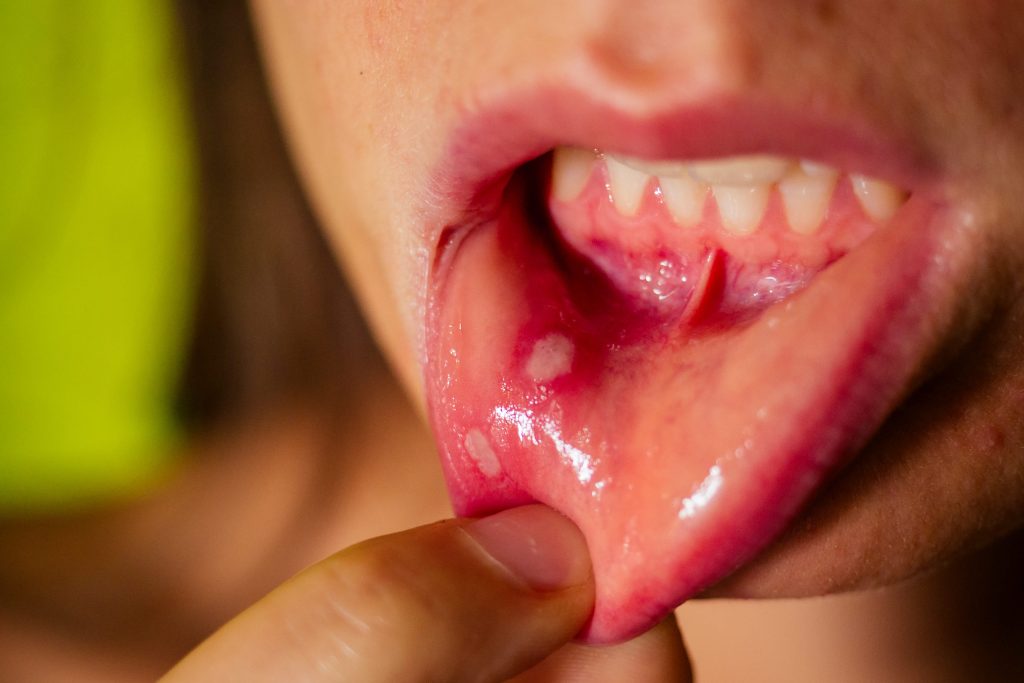
Noticing an irregularity in your mouth can be alarming. You run your tongue over it, and there it is: a small bump that wasn’t there yesterday.
It is normal for you to feel worried.
The appearance of gum lumps is one of the most frequent inquiries we receive at our clinic. Sometimes they hurt, sometimes they don’t, but they are always a message from your body.
As a dentist, my goal today is to reassure you, clearly explain what is happening in your mouth, and guide you toward the solution. The most important thing you need to know is that most cases have a simple treatment if detected in time.
Tabla de contenidos
What exactly are gum lumps?
Gum lumps are localized elevations of tissue, often filled with fluid (pus or blood) or formed by cellular growth, appearing on the gingival tissue. They can be a sign of an active infection (abscesses), a response to constant irritation (fibromas), or cysts, and they always require professional assessment to rule out serious pathologies.
Main Causes: Identify Your Case
Not all lumps are the same. To understand how to treat them, we must first identify the specific type. Here are the most common causes explained with simple examples.
1. Dental Abscess (Infection)
Imagine your tooth is like a pressure cooker. If bacteria enter the nerve (usually due to a deep cavity), an infection is generated.
The pus needs to get out and looks for the path of least resistance, creating a painful lump on the gum. If you feel throbbing pain and heat in the area, this is very likely the cause.
2. Dental Fistula
Sometimes, that lump has a small white or yellow dot at the tip. This is the “escape valve” for the abscess.
Through the fistula, the body drains the infection. Curiously, when the fistula appears, the sharp pain often decreases because the “pressure” has dropped, but the infection is still there and needs urgent treatment.
3. Fibroma (Callus from friction)
Do you accidentally bite your cheek or gums? Do you wear a denture that rubs against the tissue?
The mouth protects itself by creating a layer of harder skin, similar to a callus on your hands. These lumps are usually hard, the same color as the gum, and do not hurt. They are benign, but can be annoying.
4. Cysts and Mucocele
These are small fluid retentions. A mucocele, for example, occurs when a minor salivary gland gets blocked (common on the lip or lower gum). It’s like a small water balloon that can appear and disappear.
Doctor’s Note: If you notice a lump that changes color, bleeds without reason, or grows rapidly, Book your assessment appointment here to rule out more serious conditions.
Effective Treatments for Gum Lumps
The million-dollar question: How do I get rid of this?
The treatment depends entirely on the root of the problem. That is why we never recommend home remedies without a prior diagnosis.
If it is an infection (Root Canal)
If the origin is an infected tooth, we need to clean the inside of the tooth.
We perform a root canal treatment to eliminate the bacteria and save your tooth. Once cleaned, the lump disappears on its own within a few days.
If it is a gum problem (Periodontics)
Sometimes the lump is a periodontal abscess, caused by tartar accumulated deep under the gum line.
Here, we perform scaling and root planing (deep cleaning) to thoroughly sanitize the area. It helps the gum reattach firmly to the tooth. [See more about our Periodontal Treatments]
If it is a fibroma or cyst (Minor Surgery)
In these cases, we simply remove the excess tissue.
It is a very quick procedure, performed under local anesthesia and totally painless. In our clinic, we use laser technology so that healing is much faster and more comfortable for you.
Can I pop the lump at home?
Absolutely NOT.
I know it can be tempting, especially if you feel pressure. But pricking or popping a gum lump at home is dangerous for three reasons:
Risk of Sepsis: You can push bacteria into your bloodstream.
Superinfection: Household needles are not sterile.
Tissue Damage: You can injure healthy gum tissue, making recovery slower.
Conclusion: Your Smile Deserves Attention
Having gum lumps is not something you should ignore, but neither is it a reason for panic if you act in time. Your body is warning you that it needs help.
Most of the time, the solution is simpler and less painful than you imagine. Don’t let fear stop you from recovering your well-being.
Have you been noticing that annoyance for days? Let us take a look.
Frequently Asked Questions (FAQ)
Generally, it is not a life-threatening emergency, but it does indicate an active pathology (infection, cyst, or trauma). If left untreated, a simple infection can spread to the bone or other parts of the face, turning into a serious situation.
The price varies depending on the cause. Treating a fistula with a root canal is not the same as removing a small fibroma with a laser. At your first visit, we will give you a clear diagnosis and a fixed quote with no obligation.
No. All procedures are performed under local anesthesia. You will not feel pain during the intervention. If there was a prior infection, you might feel mild discomfort afterward, which is easily controlled with the medication we will prescribe.

